
Fuel is where generator costs become real.
A generator can look affordable on the shelf, then cost far more to run than expected if it is oversized, overloaded or simply the wrong type for the job. That matters in Australia, where more households are thinking about backup power for storms and blackouts, more caravan owners want reliable off-grid power, and more rural properties need practical options when grid access is limited.
If you are asking how much fuel does a generator use, the honest answer is that it depends on size, load and generator design. A small inverter unit running a fridge and a few lights will use far less fuel than a large open-frame or diesel set carrying a heavy load for hours at a time.
The good news is that generator fuel consumption is predictable once you know what drives it.
What affects generator fuel consumption?
The biggest factor is load.
Generators do not burn the same amount of fuel every hour regardless of what is plugged in. If you run a generator at 25% load, it usually uses much less fuel than it would at 75% or 100% load. That is why manufacturers commonly publish runtime figures at 50% load. MaxWatt notes this in its generator features guide, and its product data sheets regularly show separate runtimes based on load level rather than one flat number across all conditions. MaxWatt’s generator features guide explains that listed runtime is often based on half capacity, while product sheets such as the MX10000PES worksite generator and MX14000DSE diesel generator show different runtimes at 50% and 100% load.
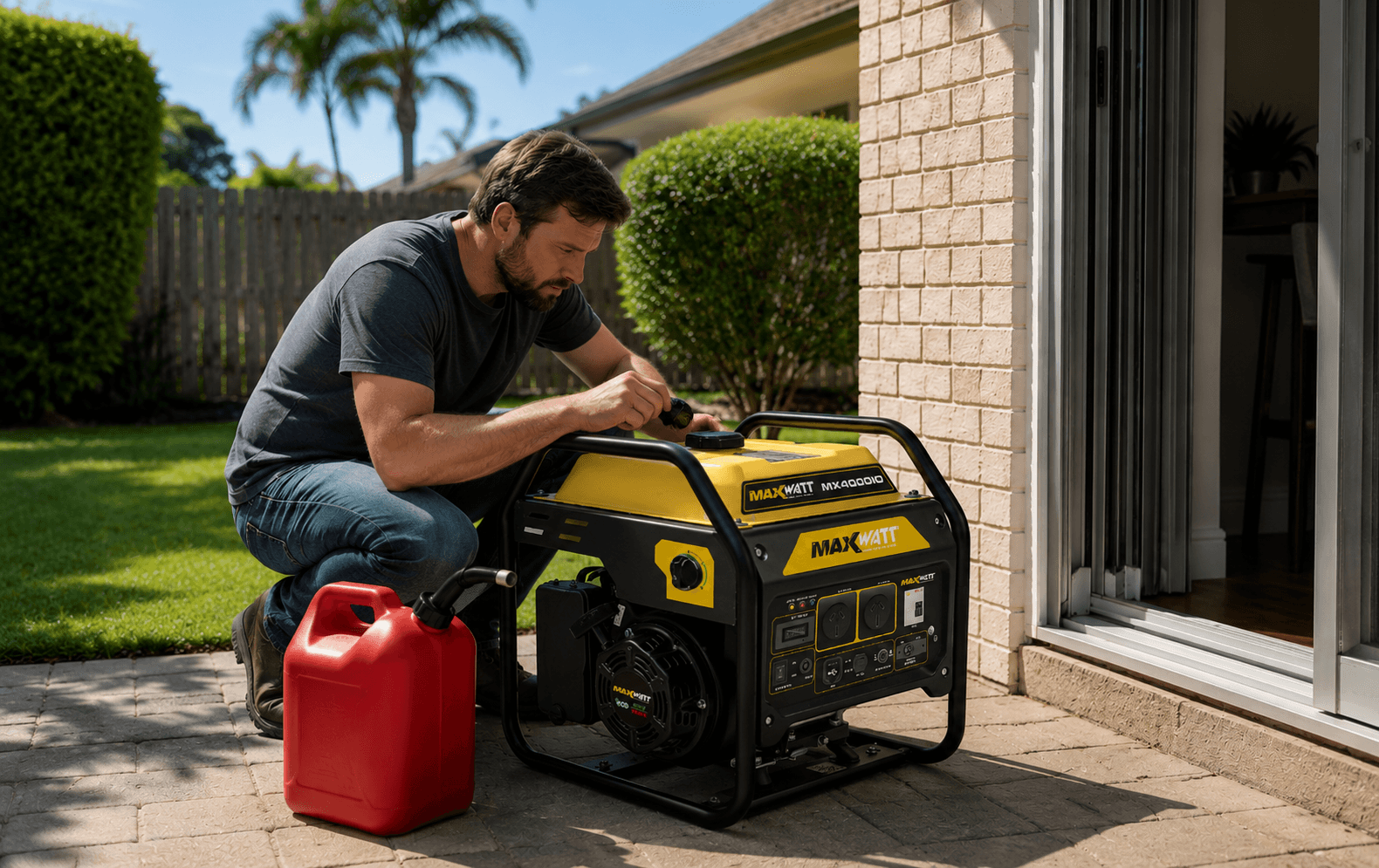
Engine type matters too. Inverter generators can reduce engine speed when demand is low, which improves generator fuel efficiency. Conventional generators usually run at a more fixed speed, so they tend to waste more fuel during lighter use. MaxWatt describes this directly on the MX4000iO inverter generator, which uses smart engine control to reduce engine speed depending on the size of the load.
Fuel type also matters. Petrol generator fuel consumption and diesel generator fuel consumption are not identical. Diesel units are often more efficient under sustained heavier loads, while petrol inverter models are popular when portability, lower noise and lighter-duty use matter more.
Then there is simple generator sizing. A machine that is too small struggles. A machine that is too big can run inefficiently for the tasks you actually have.
Generator size vs fuel usage
Bigger generators usually use more fuel per hour.
That sounds obvious, but it gets misunderstood all the time. Some people assume a bigger unit is safer because it gives more headroom, so they buy well above what they need. The problem is that an oversized generator often spends its life loafing at a poor operating point while still burning more fuel than a correctly sized model.
For example, the MaxWatt MX4000iO 4000W inverter generator has an 8-litre tank and provides up to 8 hours of runtime at 50% load. That works out to roughly 1 litre per hour under that test condition. By comparison, the MaxWatt MX10000PES 8000W open-frame petrol generator has a 30-litre tank and runs for 13 hours at 50% load, or about 2.3 litres per hour. The larger generator delivers much more output, but it also uses more fuel.
That is why generator running costs should always be considered alongside wattage. More capacity is only a saving if you genuinely need it.
For many households, caravanners and weekend users, a smaller inverter generator or even one of MaxWatt’s portable power stations can be the cheaper long-term choice for lighter loads.
Load percentage and runtime
Load percentage is where generator fuel usage becomes practical.
A generator running one fridge, a few phone chargers and some LED lights is doing a very different job from one powering an air conditioner, power tools or a water pump. More appliances usually means more fuel burned per hour.
You can see that clearly in MaxWatt’s diesel range. The MX14000DSE 10kVA diesel generator has a 30-litre tank, with a runtime of 17 hours at 50% load and 8.8 hours at 100% load. That is roughly 1.76 litres per hour at half load and about 3.4 litres per hour at full load. Same generator, same tank, very different fuel use.
This is also why storm backup plans often go wrong. People think in terms of maximum power rather than average demand. If you only need to keep essentials running during an outage, sizing for essentials rather than the entire house can cut fuel costs sharply.
Inverter generators vs conventional generators
Inverter models are often the best answer when fuel use matters.
A conventional generator is built to deliver reliable power, but it generally runs at a fixed engine speed. An inverter generator adjusts engine speed to suit the load, which can make a real difference during lighter use. MaxWatt highlights this in its inverter generator guide and on the MX4000iO product page, where fuel efficiency and smart engine control are part of the pitch.
That makes inverter units especially useful for:
- home backup during blackouts when you are only powering essentials
- caravanning and camping
- off-grid weekend use
- sensitive electronics like laptops, TVs and chargers
If your needs are modest and variable, a fuel efficient generator Australia buyers often look for will usually be an inverter model rather than a large conventional set.
Petrol vs diesel fuel efficiency
This is where usage pattern matters more than brand loyalty.
Petrol generator fuel consumption is often perfectly reasonable for short-term, portable or occasional use. Petrol inverter generators are easier to move, usually quieter, and well suited to camping, mobile work or household emergency backup.
Diesel generator fuel consumption often looks better when the generator is larger and used for longer periods under sustained load. Diesel units are common for worksites, rural properties and heavier off-grid demands because they can be more economical across extended runtime.
MaxWatt’s own range shows that split clearly. Its inverter generators suit portable and domestic backup needs, while its diesel generators are aimed more at heavier-duty use. If you need all-day runtime on a rural property or backup for larger loads, diesel may make more sense. If you want quiet operation for a caravan or short blackout events, petrol inverter power is often the better fit.
Tips to reduce fuel consumption
The cheapest fuel is the fuel you never burn.
The first step is to size the generator properly. MaxWatt’s support guide on generator sizing recommends working out your real running load before choosing a unit. That is the best way to avoid paying for power you will rarely use.
Second, prioritise essential loads. During outages, run the fridge, freezer, lights and communication gear first. Avoid switching on every appliance just because you can.
Third, choose inverter technology for light-to-medium demand. A model like the MX4000iO is designed to trim engine speed with the load, which helps reduce waste.
Fourth, consider whether a generator is even necessary for the whole job. For phones, laptops, routers, lights and small appliances, a MaxWatt portable power station can remove fuel use entirely.
Finally, keep the generator maintained. Dirty filters, stale fuel and neglected servicing can all hurt performance and economy.
Common fuel consumption myths
One myth is that a generator always uses the same fuel per hour. It does not. Load changes fuel burn, sometimes dramatically.
Another is that bigger is always better. Bigger is only better when you need the capacity. Otherwise, it can mean higher generator running costs for no benefit.
A third is that diesel is always cheaper to run. Sometimes it is, especially under heavy sustained loads. Sometimes a smaller petrol inverter is the more economical option because the total job is smaller.
The last myth is that every blackout needs a full-size generator. In many cases, a modest inverter generator or power station is the smarter answer for Australian homes dealing with short outages, storm seasons or weekend off-grid use.
Choosing the right generator size to save money
The best way to cut generator fuel consumption is to match the generator to the work.
For backup power at home, that may mean an inverter unit sized for your fridge, some lighting, internet equipment and a few kitchen essentials. For caravanning, it may mean a compact model that can run chargers, a coffee machine or a small air conditioner without hauling around excess capacity. For farms and rural blocks, it may mean stepping up to diesel because the loads are heavier and the runtime is longer.
MaxWatt’s range gives you room to make that decision properly, from inverter generators for lighter and quieter use, to open-design petrol generators, off-grid generators and diesel generators for larger jobs.
The cheapest generator to own is rarely the one with the lowest sticker price. It is the one that fits the load without wasting fuel every hour it runs.
FAQs
How much fuel does a generator use per hour?
It depends on the generator’s size, fuel type and load. A smaller inverter model such as the MaxWatt MX4000iO runs up to 8 hours on an 8-litre tank at 50% load, which is about 1 litre per hour. Larger petrol or diesel units can use well over 2 litres per hour, especially under heavier loads.
Do inverter generators use less fuel?
Usually, yes. Inverter generators are built to vary engine speed based on power demand, so they can use less fuel when running lighter loads. MaxWatt’s inverter generator range is designed around this kind of efficiency. They are a strong choice for camping, caravanning, home backup and other situations where demand goes up and down.
Does generator size affect fuel consumption?
Yes. Larger generators generally use more fuel per hour because they have larger engines and higher output capacity. If you buy a generator that is much bigger than your actual needs, you can end up with unnecessary fuel costs. A correctly sized unit is usually the best way to improve generator fuel efficiency and keep running costs under control.
Is diesel or petrol more fuel efficient?
Diesel is often more fuel efficient for larger generators running for long periods under steady load. Petrol can still be the better option for lighter, portable and occasional use, especially with inverter technology. The right choice depends on how often you use the generator, how long it runs, and whether portability or heavy-duty runtime matters more.
Can an oversized generator waste fuel?
Yes. An oversized generator can burn more fuel than necessary if it is regularly powering only small loads. You are paying for capacity you are not using. That is why it is worth calculating your real running watts before buying. Matching the unit to your normal demand is usually more economical than buying the biggest model you can afford.
How can I reduce my generator’s fuel consumption?
Start by choosing the right size generator for your actual load. Run only essential appliances when possible, keep the unit serviced, and consider an inverter generator for variable or lighter demand. For very small backup needs, a MaxWatt portable power station can remove fuel costs altogether for phones, lights, routers and similar devices.
How long will a generator run on a full tank?
Runtime depends on tank size and load. For example, the MX4000iO runs up to 8 hours at 50% load on an 8-litre tank. The MX14000DSE diesel generator runs around 17 hours at 50% load on a 30-litre tank, but much less at full load.
Does running more appliances use more fuel?
Yes. More appliances increase the electrical load, and a higher load makes the engine work harder. That usually means more fuel burned per hour. A fridge and lights will use far less fuel than running a large air conditioner, multiple power tools or pumps. Managing what you run is one of the easiest ways to reduce generator running costs.