
A generator that trips the moment a saw starts is worse than useless on a worksite.
Tradies need power that starts cleanly, handles load spikes and keeps working through dust, transport and long days. That is why the best tradie generator is rarely the cheapest one on the shelf. It needs to match the tools you actually run, the length of your day and the conditions on site.
For Australian builders, sparkies, chippies and rural contractors, that decision matters even more now. Storm-related outages, remote builds, off-grid jobs and regional work all create real demand for dependable backup power. MaxWatt’s worksite generator range is built around exactly those use cases, from portable inverter units through to large diesel models suited to heavier commercial demand.
Start with the load, not the label
The biggest sizing mistake on site is buying by category name alone. “Construction generator” sounds right, but wattage is what decides whether a unit will actually do the job.
Most worksites run a mix of tools with different start-up demands. A circular saw, mitre saw or grinder may have a manageable running load, but the start-up surge is what catches people out. Compressors are even more demanding because motors draw a sharp spike when they kick in. Welders can be heavier again, depending on process and output. If you size the generator only to the running watts, you risk nuisance shutdowns, poor performance and tool damage.
MaxWatt’s own Generator Selector reflects that reality by guiding buyers to match intended use and power needs with the right product. On construction sites, the smarter approach is to total your running load, identify the highest start-up surge, then leave headroom so the generator is not working flat-out all day.
Power tools need stable output, not just raw watts
A lot of tradies assume any big enough generator will run their tools. Sometimes it will, but raw wattage is only part of the story.
Power tools, chargers and site electronics all benefit from stable output. SafeWork NSW notes that construction and demolition sites have specific minimum requirements for electrical installations and low-voltage generators, including compliance with relevant Australian Standards for generating sets and site electrical installations. That makes generator quality and site suitability more than a convenience issue, it is part of safe site setup in Australia.
For builders using drop saws, battery charging stations, laser levels and other sensitive gear, an inverter-style portable worksite generator can be a strong fit. The MaxWatt MX11000I is a good example. It delivers 8500W continuous and 9000W peak power, uses inverter technology, and includes 15A and 32A IP-rated outlets. MaxWatt lists up to 16 hours of runtime at 50% load and multiple start options including recoil, electric, remote control and 2-wire auto start. That combination suits crews that want cleaner power with enough capacity for a serious mix of site tools.
If your day involves a mix of saws, drills, chargers and intermittent heavier tools, this kind of inverter worksite generator often gives the best balance between output, portability and power quality.
Compressors and higher inrush loads need extra headroom
Compressors separate average generators from genuinely useful site generators.
Air compressors do not just need power once. They cycle on and off all day, and every restart can hit the generator hard. That means your construction generator should have enough reserve capacity to absorb those repeated surge loads without labouring.
For midsized site setups, the MaxWatt MX10000PES makes sense. It delivers 7500W continuous power and 8000W maximum power, uses a 457cc 4-stroke engine, and includes two 20A 240V IP66 socket outlets plus an RCD safety switch. MaxWatt states that it can run for up to 13 hours at 50% load from its 30L tank, with electric, remote and recoil starting options.
That makes it a practical tradie generator for crews running multiple tools at once, especially where a compressor is part of the daily setup. The heavy-duty frame, wheels and handles also matter more than people think. A generator that is awkward to move tends to stay in the wrong place, and that usually means longer leads, more site clutter and more wear.
Can it run a welder? Sometimes yes, but size matters
Welders are where casual generator buying usually falls apart.
Some smaller units may handle light-duty inverter welders, especially if no other heavy tools are running at the same time. But once you move into longer duty cycles or larger machines, you need serious capacity and a generator designed for harder commercial use.
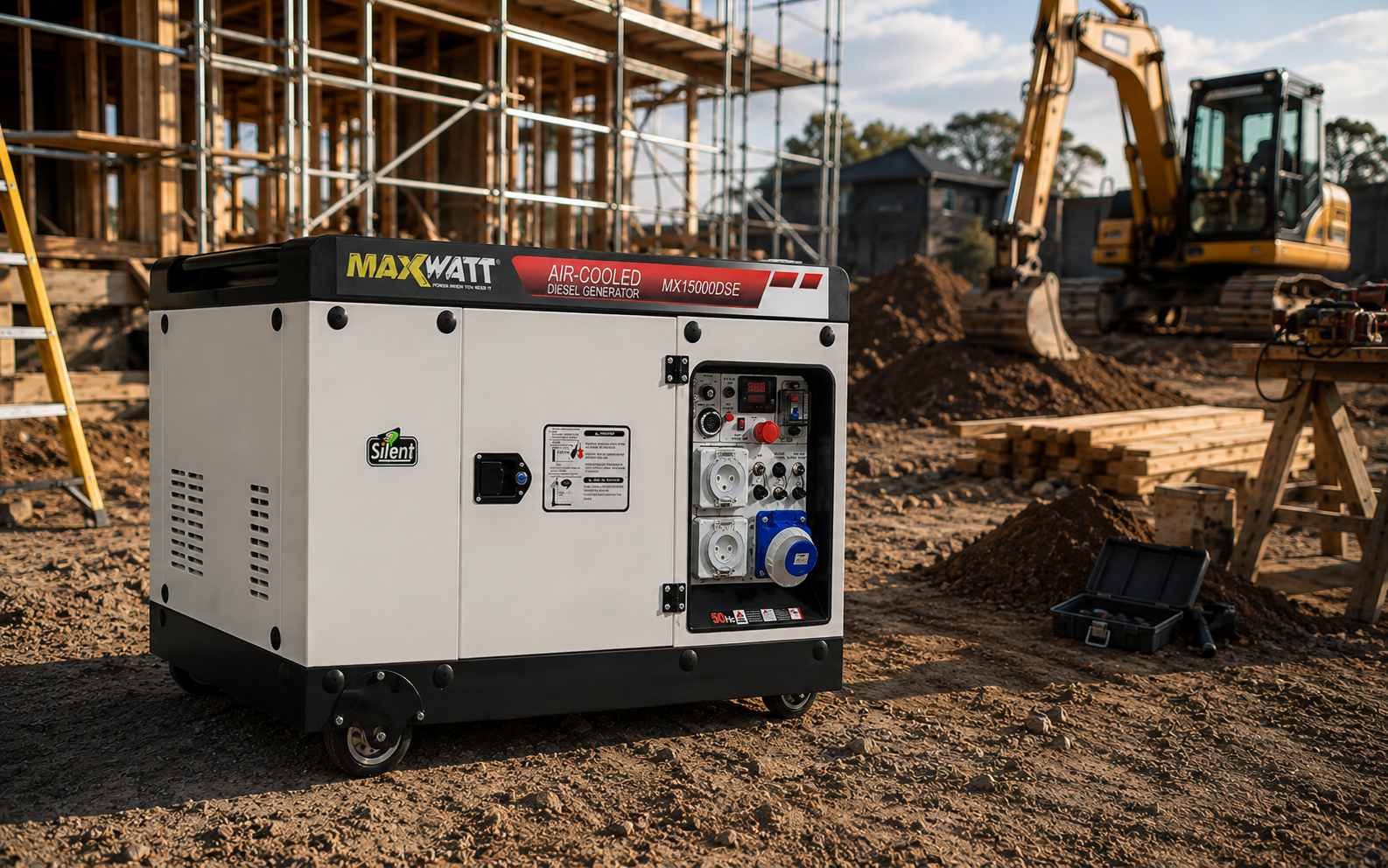
That is where diesel starts to come into the conversation. For heavier site demand, the MaxWatt MX15000DSE is one of the stronger options in the range. It provides 11,500W continuous power and 12,000W peak power, with 32A and 63A IP-rated outlets, electric and 2-wire auto start, and a 999cc diesel engine. MaxWatt lists up to 14 hours runtime at 50% load in the detailed specifications, along with a low-noise enclosure and four-wheel transport setup.
For welders, compressors and several tools running in parallel, this is the sort of output level that moves a generator from backup accessory to true commercial generator Australia territory.
Petrol or diesel: which is better on site?
There is no universal answer, but there is a practical one.
Petrol generators are often a smart choice for tradies who need portability, easier transport and flexible use across short-to-medium daily jobs. They suit mobile crews, residential builders and contractors moving between sites.
Diesel generators usually make more sense where loads are heavier, runtime is longer and the generator is effectively part of the site infrastructure. WorkSafe Victoria’s guidance on portable generators notes that where mains power or a diesel generator is practicable, diesel may be preferred over petrol on some construction sites because petrol handling creates ignition risks during refuelling. That does not make petrol unsuitable, but it does explain why many larger worksites lean diesel.
A diesel worksite generator also tends to appeal for fuel efficiency and long-haul durability. MaxWatt’s diesel generator range and off-grid generators line up well with remote properties, regional contractors and buyers who also want blackout backup for sheds, workshops or rural homes.
Durability is not a bonus feature
Australian worksites are hard on equipment. Dust, rain, corrugated roads, muddy access and rough loading habits will quickly expose a weak frame or poor outlet protection.
That is why durability features deserve as much attention as wattage. IP-rated outlets, wheel kits, strong frames, low-oil shut-off and proper circuit protection all matter. MaxWatt’s worksite-focused models repeatedly include those details, from the MX10000PES with IP66 outlets and RCD protection to the MX11000I with IP44 and IP66 outlets, and the MX15000DSE with heavy-duty outlet options suited to larger loads.
Safe operation matters too. Queensland’s Electrical Safety Office advises that portable generators can be used for small power tools and similar equipment where electricity is unavailable, but they must be used correctly and never in enclosed spaces because of exhaust risks. On any site, the right machine still needs the right placement, ventilation and lead management.
The best generator is the one that fits the job pattern
For many builders, the best choice is not the biggest unit. It is the one that matches the way the crew actually works.
If you need cleaner power for tools and electronics, an inverter model like the MX11000I is a strong all-rounder. If you want a solid petrol option for everyday building work, the MX10000PES covers a lot of ground. If the site load includes welders, larger compressors or long-hour commercial use, the MX15000DSE is closer to what a heavier construction generator should look like.
For smaller crews, a unit like the MX7000ES can also be a practical step up from entry-level models, with 5000W continuous output and up to 17.5 hours runtime at 50% load according to MaxWatt’s specifications.
The point is simple: buy for the site load you have now, plus a bit of headroom for the jobs you are likely to take next.
FAQs
What generator runs power tools?
A generator for power tools should provide enough continuous wattage for the tool’s running load and enough extra capacity for start-up surges. For many tradies, an inverter or worksite model in the 5kW to 9kW range is a practical starting point. If you run several tools together, or add chargers and lights, you will usually need more headroom than the tool labels suggest.
Can I run a welder?
Yes, but it depends on the welder’s power draw and whether other tools are running at the same time. Light-duty inverter welders may run from a larger portable unit, while heavier welding setups usually need a much bigger generator with stronger continuous output. On busy sites, diesel models with higher wattage are often the safer choice for stable welding performance.
Which generator is best for builders?
The best generator for builders is usually a portable worksite generator with stable output, strong surge handling and site-ready durability. For general building work, a petrol or inverter unit can be ideal if you are moving between jobs. For larger builds, longer runtimes or heavier equipment, a diesel generator is often the better fit because it handles sustained demand more comfortably.
Is diesel better on worksites?
Diesel is often better on worksites where loads are high, runtime is long and the generator stays in regular commercial use. It is commonly chosen for heavier-duty jobs because it can be more fuel-efficient over long operating periods and is often preferred on larger sites. Petrol still suits many tradies well, especially for mobile, smaller or short-duration building work.
How much power do I need?
Start by adding the running watts of every tool you expect to use at the same time, then identify the tool with the biggest start-up surge and allow extra capacity for that spike. A good rule is to leave headroom rather than sizing the generator right to the limit. If compressors or welders are involved, step up more aggressively because those loads are less forgiving.